#19 Leave it to the Beaver

beaver


We didn’t eat out often; we didn’t have the money for it, and my dad ate out in barrooms every night during the week, so when he came back to Parkersburg he wanted home-cooked food. Even so, there were a few places we went to. My favorite, and where we went with regularity, was The Clam House on 7th street. We would always walk through the dimly-lit first floor dining area and head upstairs where there were booths and a colorful, bright jukebox. There was usually no one up there besides us, which my parents liked because my sister and I could walk around, play the jukebox and goof off while my mom and dad enjoyed their own company. Did they serve alcohol there? I can’t remember. If so, my dad would have been drinking a beer.

My sister and mom usually ordered the shrimp, I can’t remember what my dad ate, and I always had the frog’s legs, a delicacy that you don’t find in restaurants much these days. When I do locate it on a menu and order it, I don’t find it nearly as exotic or delicious as I did back then.

As I would eat my frog legs, my dad would sometimes tell stories of when he was a young man and worked during the summers in the Adirondack Mountains at a resort for wealthy vacationers. One of the unusual tasks assigned to him was to take the young ladies of the gentility out in little rowboats where they, the ladies, would sit in the front of the boat as he rowed them along the banks. When they spotted a bullfrog, the ladies would take shots at them with miniature, silver-plated BB guns. It was an image we always remarked on: silver BB guns! Who could imagine such a thing? Surely these must have been the richest people in the world. If they hit the frogs, Dad collected them and the catch was brought back to the kitchen and would be served later that evening to the huntresses for dinner. And isn’t that a vision of a world long gone?

It was at the Clam House that I had another of my revelations into the pain of being not believed by adults. The Clam House had a garden beside the restaurant, situated between the restaurant and another building about fifteen feet away. There was a small artificial stream that meandered along in a concrete gutter in this little garden. There were a few decorations, primarily a walking bridge over the concrete stream and a four-foot tall windmill of the type you might find at a miniature golf course. Were there goldfish in the stream? Probably not, but maybe. While waiting for our food to arrive, I would be allowed to go downstairs and walk around this mini-garden. One afternoon, I must have been six or seven, I came face to face with a “beaver” sitting on the little bridge. No one else was around. We locked eyes, boy and beaver. Surely this was a tame animal, brought in by Old Captain Doug to lend some realism to the garden? Would he (the beaver, not Captain Doug) dam the concrete stream with concrete logs and create his own pond right here next to the Clam House?

I approached the bridge where the little fellow was sitting up on his hind legs, staring at me. Maybe I could I pet him.

Suddenly he charged straight at me and before I could dodge the attack, he bit me savagely on the shin and ran off. I was stunned. I ran back upstairs, blurted out my story and showed my parents the two angry red beaver bite marks on my shin. There was no blood, but there were a couple of serious red dents. Everyone laughed at me. Beavers! they exclaimed, there are no beavers at the Clam House!

I was crushed. Mortified. When our dinner orders arrived my frog legs were as ashes in my mouth, and I was close to tears. Every once in awhile I checked my beaver bite. The two teeth marks, and the pain, slowly faded. But the humiliation remained.

On thinking back now I guess I had confronted a groundhog, not a beaver, but surely someone should have believed this small boy. But no, they did not, and one more black mark against unfair, disbelieving adults was chalked up on my growing list of grievances.

There may have been fancier restaurants in town, but we didn’t frequent them. I remember spaghetti joints and home-cooking places and barrooms that served food as well as beer.

My one experience of fine dining came courtesy of my band friend Bill Shattuck’s father. I’m not going to give him a fake name because I admired him so much. He was a tall (of course everyone was tall to me) handsome man who had a commanding air about him, which befitted his status as an executive at one of the chemical plants that lined the nearby Ohio River. Mr. Shattuck liked me, though I have no idea what he saw in this undersized, teenaged West Virginia rube. Maybe he thought of me as something of a “project,” in that I was a nice kid who didn’t have many opportunities of the type his son, my friend, enjoyed and that he would, graciously, give me some and pointers. Whatever reason, he was one of the kindest men I have known. He actually once took me along on a business trip to Chicago even though Bill decided he didn’t want to go. I’m sure I embarrassed him by standing on the broad avenues, slack-jawed, staring in wonder at the towering buildings around me. We flew in an airplane (I know, what else would we fly in?) to get to Chicago, obviously my first airplane ride. I remember it vividly. The plane was a DC-3, a plane that saw much service in WWII. If I had examined the fuselage I might have found patches indicating where the plane had been hit by flack while attempting a bombing run on some Nazi outpost. It had two prop engines and since the back wheel was much smaller than the front it sat back on its tail. You entered through a hatch toward the rear of the airplane and had to climb up what seemed like a fairly steep incline to get to your seat. The thing I remember most about this airplane was that there was a handrail that ran down the center of the aisle that you used to help haul yourself up. This handrail was made of a piece of pipe just like the ones in the basement of our house that carried the hot and cold water. It had regular pipe fittings at the ends and was attached by bolts at the bottom on the floor of the plane. Even to one as inexperienced as myself it seemed like a pretty crude solution to the problem of putting in a handrail. I had a moment’s worry when I saw this, wondering if that’s what I could see, what else was in this plane that I couldn’t see? Were the engines held on by 2×4’s hammered in with ten-penny nails? Anyway, it took off just fine and we made it to Chicago and back without trouble.

Around the time of my joining the band, my first year in high school, the Shattucks invited to me to dinner at the country club they belonged to. This was standard fare for Bill, but for me it was a special, and daunting occasion. We sat down at an elegant, to me, table with a white tablecloth, crystal clear drinking glasses and lots of silver implements. Of course I was in my best clothes, yes, that damned striped Sears and Roebuck clown coat. I was handed a menu the length and breadth of which I had never seen before. Once again I have to repeat, I wasn’t stupid, I had read a ton of books and seen plenty of movies where fancy people sat down in fancy restaurants and ordered fancy meals, it was just that I wasn’t one of those people. I could read, yes, make sense of the menu offerings, yes, but the etiquette challenges in this undertaking were a vast looming chasm, on the brink of which I precariously balanced. After I found the entrees — I wasn’t even going to think about the appetizer section – a quick search showed me they didn’t sell frogs legs, so there was not going to be an easy out for me. Wise Mr. Shattuck, sensing my stupidity and hesitation, suggested that the steak was very good there.

Steak! I knew what steak was! On rare, ceremonial occasions my dad would cook steaks at home, always T-bones. It was one of the few foods that he alone prepared, along with grilled hamburgers and hotdogs, baked banana bread and showing us how to eat sardines on crackers, which my mother loathed. We were only permitted to eat sardines after she had gone to bed on the weekend.

I found the steak section on the menu. My mind boggled at the prices. I decided that I would order ground steak, whatever that was, because it was the cheapest steak dish offered. Wasn’t this the way a good guest should behave?

When the waiter came to take my order, I ordered the ground steak, which came with green beans and a baked potato. I was on pretty solid ground with green beans and a potato. After I told the waiter my selection, Mr. Shattuck said, quietly, while pretending to scrutinize the menu, “I’m sure the ground steak is very good, Allen, but might I suggest that you try the rib steak? I’ve had it here many times, and I think you’ll like it.”

I understood he was tossing me a lifeline, so I grabbed it, nodding sagely to the waiter, agreeing to the rib steak, grateful to Mr. Shattuck for being a host who treated me with the utmost generosity, delicacy and tact. Gratitude washed over me.

When I cut into my thick, juicy, rare steak — my father taught me that we Appels always ordered our meat rare, our liquor straight, and our iced tea unsweetened — I suddenly understood that in the realms of the moneyed classes and in the larger world that existed beyond Maxwell Avenue, a steak was not just a steak. The T-bones my dad brought home were good, yes, but they were thin, poor relations to this beauty that sat on my plate, swimming in its ruby red juices. It was a marvel to me. Each bite was a new experience. I could have closed my eyes and wept.

But we are not yet done with this amazing meal.

We were all sawing away at our steaks except Bill’s mom, who was smoking a cigarette and drinking a martini. She was a tall, (dear reader, I’m sorry I always begin my physical descriptions with the word tall, but by now you know why) thin, elegant woman who I never saw eat anything. I think she was far more interested in the martini than the food. I had never seen a person in real life drink a martini.

I saw Bill, across the table from me, butter up his baked potato and slather on a thick white substance that was in a small bowl in front of us. “What’s that?” I asked.

“Sour cream,” Bill said, piling some more on. “Try it, it’s good.” If he was mystified at my ignorance, he didn’t show it. Maybe they had a pre-meal meeting where everyone discussed how to treat me, the ignorant simpleton dressed in his clown coat of many colors, without hurting my feelings. At any rate, no one laughed. I hesitantly spooned a dollop of sour cream on my potato.

Oh, God, it was delicious, the sour mixing with the sweet butter to flavor what was just an ordinary potato, lifting that simple vegetable onto a new, unknown to me, level of foodness.

As I sat there, eating my potato, I wondered how on earth something that was soured, this cream, could be so exquisite. Didn’t soured mean spoiled? Not for the first time, I wondered what else was out there in the wide world that I had absolutely no knowledge or experience of. Well, it turns out there was, and is, still a hell of a lot out there.

I have since eaten in some of the greatest restaurants in the world. My son is a chef in a three star Michelin restaurant, and he has cooked things for me that would astonish anyone.

But that simple potato, served to me back in Parkersburg, West Virginia, 55 years ago, remains the greatest food that I have ever eaten.

 

#18 You Want to Fight?

tumblr_lyqhx7ld8e1qa70eyo1_500


One of the trips my first year in the band, fall of 1959, was a bus trip to some small high school with a ramshackle stadium, and, probably, a hapless football team that was destined to be steamrolled by the juggernaut that was the Big Red football program. I have forgotten what the school was named or where it was, but I remember their stadium as being sad, old, and beat-up. Of course no stadium looked as good as PHS in those days. In the next three years we never went back to wherever this was. I wonder if it was because of what went on with the band after the end of the football game.

We were forming up on the cinder track, getting ready to go on at halftime. We were down at the end of the field, a good distance from the sparsely attended ramshackle bleachers. There was a chain-link fence that separated us from a dimly lit parking lot. As we were waiting, a gang of around a dozen young men sauntered up out of the parking lot, scattered along the chain link fence and started yelling at us. I can’t remember the threats and curses of the time, but it’s a safe bet the word “queers” was somewhere in there. Frank said something to the head drum major, and he whistled us into formation and attention. Frank gave us an “eyes front,” so we weren’t looking at the gang. We knew better than to break formation or say anything. We waited. We ignored their taunts. Frank stood in front of the band.

A loud clang rang like a brass bell as a rock struck one of the big sousaphones. Frank came trotting back beside us at the fence. The following conversation took place. Maybe not in these exact words, but this is the way I remember it.

Frank: “What do you guys want?”

These guys were what we called greasers or hoods, a term I’ve explained earlier. They weren’t high-schoolers, were probably drop-outs, but they weren’t really functioning adults yet either. They had hood hairstyles, long greasy hair swirled into pompadours or the ever-popular buzz cut. They wore hood clothes: leather jackets, white T-shirts, cuffed blue jeans and heavy black boots. James Dean-style hoods.

Gang leader: “We want to kick your queer asses.”

Frank: “We’re not interested. We’re busy.” He glanced over at the field and saw that the home team band was finishing up whatever pathetic drill they had put on, (they were the sort of band who allowed girls as members and carried their music on their arms) and that we needed to get into place behind the goalposts. He turned away and trotted back toward the front of the band.

Clang! Another rock hit a sousaphone, and Frank went into full Teutonic, V-2 rocket mode. He ran back to where the hoods were.

“OK,” Frank yelled at the leader, “You want a fight? You’ve got it. We’ll meet you back here after the game. You’d better round up some more guys, because we are going to kick your asses. Right here! After the game!” He whirled around and blew his whistle and the drum major blew his and the drummers got us marching to our position. We did the drill and went back to the sidelines where the rest of the football game played out. Nobody talked about what Frank had said. He stood off to the side by himself, which is where he always stood, dealing with his fingernails as always, but you could tell he was really pissed off. The game ended. Frank came to the front as we were getting up from our chairs.

“Leave your instruments, we’ll get them later. Form up on the track and get into position. Some guys want to fight us, so we’ll fight. Nobody throws rocks at the Big Red Band. The older guys will tell you what to do.” He walked over to the cinder track and waited.

This was pretty thrilling. Good thing I couldn’t see myself — there I was, this tiny kid putting his piccolo down and turning to one of the older guys. A few of us gathered around him (clarinet) and he gave us a demonstration. The rest of the guys were huddled in small groups.

“Take off your belt,” the older boy said. We wore what is called a Sam Brown belt. The always helpful Wiki tells me it was named for its inventor, Sam Brown — what a surprise — who was a soldier who had had his left arm cut off in a sabre fight and needed a way to keep his blade from clanking around when he was running into battle, one-armed. What typifies the belt is a smaller belt that runs from left to right over the shoulder, which allows the waist belt to hold up any amount of equipment that you want to pile on. The main part of our belt, the part that goes around the waist, was four inches wide, white, and had a very large, square, brass buckle in the front. I see from videos of today’s Big Red Band the belts now have two crosspieces over each shoulder. The older guy showed us how to wrap the belt around your fist so that the belt buckle ended up on the knuckle portion of your hand. That way when you punched someone the buckle did some serious damage, especially if the prong thing happened to be sticking forward when the punch was thrown. Let it be noted that belts of this type could also be usefully employed in a fight by swinging them overhead and smashing them into opposing faces, but we, the band, did our fighting in close formation and didn’t have room to swing anything without possibly hitting our own guys.

I wrapped my belt around my tiny fist and was inordinately proud. I was a warrior, going into my first battle. The drum major whistled us into close formation, four abreast, on the narrow cinder track.

Being the drum major of the band was an extremely important position. Traditionally, the DM is, physically, a big guy. Historically, and by that I mean back in history, part of the DM’s job was to preside over any flogging that had to be done, not that there was any flogging being done in the Big Red Band. Just ass kicking. That year, my first year in the band, our drum major was really tall (especially when I stood next to him) and really tough. He wore one of those beaver fur hats, the sort that the guards at Buckingham palace wear only white, and he carried a long, heavy baton, which he could use to beat the shit out of people. With the hat, our guy stood around eight feet tall. Picture him at the front of our Big Red phalanx as we marched into battle.

We had to exit the stadium, which by now was largely empty, and make our way around back to the dark parking lot. I’m sure that Frank was hoping for a certain amount of discretion on our part, as what we were about to do would surely be frowned on by any authorities. We were in a really hick burg; who knows what side the cops would be on? Even Frank wasn’t about to take on guys with guns.

Today, what we were about to do would be considered insane, especially because the gang we would be going up against would be armed with street weapons featuring names like Glock and Beretta. Back then there were knives and whatever clubs could be picked up along the way.

One of the many things that struck me as we went about getting ready for the fight was how calm and matter-of-fact everyone was. The new guys kept their mouths shut because they knew they had nothing to add and everything to learn by paying close attention, and the older guys acted like it was completely familiar and nothing to get excited about, as if they had made these preparations many times before. And perhaps they had, I didn’t know, this was my first year. As always, everyone seemed perfectly confident that the band would prevail.

Picture it. We were drawn up in a solid, tight formation, red uniformed phalanx. In front was the head drum major, an eight-foot giant wielding a long metal pole. There were a couple of slightly smaller drum majors just behind him. And by his side was our stone-faced, very pissed off German leader, Never-Throw-Rocks-At-My-Sousaphones, Frank. Frank tossed out a command, “On the rim.” The drum major lifted his baton and brought it smartly down and the drums began the cadence.

“On the rim” meant the drummers used the wooden rim of the drumhead, rather that the drumhead itself. This was employed when we wanted to get someplace fairly quietly, but still needed the cadence to stay in step. It produces an odd sound, and on this night, lit by the stadium lights behind us and headed for a dark parking lot, it sounded like the rattle of old, dry bones. Our shoes crunched in unison on the cinder track. Other than these two sounds there was complete silence.

As we approached the lot, we saw the gang appearing out of the shadows. They had indeed called up some reinforcements. Twenty or thirty of them were walking slowly toward us. Some of them were carrying baseball bats and lengths of wood. I was scared shitless but marched along in step with everyone else.

Frank nodded at the drum major who blew a long, very loud blast on his whistle, and the drummers switched from the rim to the head of the drums. After the ominous clacking of the rims, the effect of the massed drums was thundering. I wish I could have stepped aside and just watched this sight: the solid band of red-uniformed young men, belt-wrapped fists, the roaring of the drums. I’m sure it was impressive. Even now it gives me a slight chill remembering it.

After standing their ground for about five seconds, the gawking gang melted away back into the darkness. In another five seconds they were gone. The drum major whistled us to a halt, and we stood there, in the dark, at attention, in complete silence. After a minute, Frank said, “At ease. Go get your instruments and get on the bus. It’s over.”

And it was.

Here’s a lesson about Frank Schroeder. He was never a friend to any of us. He was hard man and took no crap from anyone. He would kick your ass if you screwed up. He demanded as much perfection as he could wring from 80 high-spirited, young men. And he got very angry when anyone threw stones at his sousaphones. You may not have liked him, but by God, you feared and respected him.


#17 Rocket Boys

allen and Rusty science fair

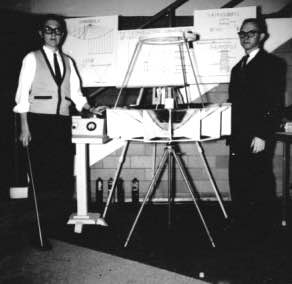
The picture is of me on the left and Rusty on the right in Rusty’s basement with our science project. We were converting electricity through heat. Our pal Stoney was involved with the project as well. Are there two more dorkey-looking teenagers in the entire world? If you don’t know who Rusty is, read the entry, #15 The Carnegie Library, Den of iniquity.

Rusty and I found each other in the first year of the band. He wasn’t much bigger than I was, we shared a love of books and classical music, and we were equally inept at finding girlfriends. Rusty was shyer than I, but he was far smarter. Where I maintained a straight C average, (with other highs and lows) he received mostly A’s. He studied; I didn’t. We teamed up to be in the Science Fair together and won one of the top prizes. In a pale imitation of the young man who wrote the bestselling book, Rocket Boy, the writer Homer Hickam from Coalwood, West Virginia, we even crafted an elegant model rocket. More on that adventure below. After reading Hickam’s excellent rocket book many years later, my mother would tell anyone who would listen that Hickam had stolen the idea of building rockets from her son’s foray into that field.

Rusty lived about twenty miles outside of town, so we mostly hung around together in school. His father was a silent, gruff, tough man who scared the shit out of me. It was clear (or at least I thought it was clear) that his father didn’t much care for Rusty’s pursuits – playing classical piano, reading, getting good grades, being in the band and hating all sports – and he didn’t like me. When he spoke to us at all the tone was slightly scornful, a tone that made me feel even smaller than I was.

His mother, on the other hand, liked me. Even more than my other friend’s mothers, she was quiet, and I never could tell what she was thinking. She was an attractive blond and when we were at Rusty’s house you never knew where she was, always sitting quietly by herself in one of the rooms of her impeccably clean house.

One day I was headed to the bathroom, coming upstairs from the basement where we hatched all of our science and other projects, and I heard a bird singing in the house, loudly, unlike any bird I had ever heard. I came into the kitchen and found Rusty’s mother sitting at the kitchen table, looking at a bright yellow canary in a domed wire cage. (I almost wrote “doomed wire cage.”) The bird continued to sing, and Rusty’s mom smiled at me. The birdsong was beautiful — clear, liquid. I think this moment sparked my lifelong interest in canaries and birds in general. As an adult I raised them and became an avid bird watcher. I didn’t say anything, not wanting to break such an obvious spell. I smiled back and walked through the living room to the bathroom. When I came back out I stood in the living room for a minute, watching Rusty’s mother. She didn’t see me in the other room. The sun had come out from behind a cloud and light streamed through the kitchen window directly on her and the canary. The scene was splashed a golden yellow: her hair, the bird, the table. Her smile had vanished, replaced by the saddest, most faraway look that I had ever seen on an adult. Once again, the symbolism is obvious as I write about this moment — the lonely wife, the taciturn, remote husband who kept her trapped — not in the tower of a castle — but in this ordinary suburban home.

Remember, I was a very young man and had grown up reading romantic adventure books where such heroes, heroines and villains were commonplace. Life then (my real life) was a series of events that occurred one after another, and I encountered them, dealt with them and moved on to the next. There’s not much room for introspection in a fourteen-year-old boy’s mind.

I went downstairs and continued whatever project Rusty and I were working on. But I have never forgotten the image of that moment, and the story that my mind made up about it. The only thing missing was a hero to come riding in to rescue the Princess. I wonder if somehow that moment was a seed, implanted in my subconscious that many years later bloomed into my garden of novels. All of which, God help me, hew fairly closely to that old formula: Villain, Hero, Doomed Princess.

Can a single moment shape a future? I don’t know. But I think, from this 50-year distance, that it’s possible that just such a moment can color a future. Ah, it’s so hard to say, to guess, to make these connections. All we have are our memories. Who can say what they mean?


OK, the rocket mentioned above. In a less science-inspired moment, Rusty and I decided to build a small rocket that we would fire off in some as yet thought of location. At the expense of once again sounding like an old geezer, (“By cracky, I remember helping the Wright boys get that damn contraption into the air.”) you might remember this was just around the time that Russia launched their Sputnik into space. Even West Virginians were excited about the possibilities of space flight.

Our “rocket” was far from Homer Hickam’s elegant flyers. I’m not trying to convince you we were anything special when it came to rockets or science. The real point of this story is to relate one more example of kids doing things back then that could have easily resulted in death. Trying something like this today would result in jail time for anyone involved, even a well-meaning adult like my dad.

The rocket was a fifteen-inch section of aluminum pipe with a balsa wood nosecone, a rear nozzle carved out of a piece of asbestos, and sheet-aluminum stabilizing fins. I can remember leaning in close to my bench clamp, filing away at a chunk of grey asbestos, fashioning it to fit the rocket. Of course I didn’t know that I was probably inhaling a lethal dose of cancer-causing particles in the process.

My dad volunteered to help Rusty and me fire off the rocket. I guess he might have offered so he could keep us safe in the process, but I think he was just interested in seeing what would happen. We had all seen countless film clips on television of rockets roaring into space, this could be just as majestic, except on a much smaller scale. Right?

Our fuel was gunpowder, so you’d think we would have some notion what was going to happen. And where did we acquire enough gunpowder to load a 15-inch metal tube? Well, boys and girls, back then the basic materials were pretty easy to come by. The drug store would sell you saltpeter, (potassium nitrate) which was the primary ingredient. Charcoal was next, which we obtained by grinding up briquettes. And sulphur, which we didn’t need much of… well, I can’t remember where we got that. Just picture it: two fairly clueless boys down in their basement workshop, grinding up gunpowder and tamping it into a metal tube. Upstairs, even more clueless parents, watching TV, going about their daily lives, unaware that the house was only inches away from being blown to smithereens. And remember, we were the smart kids, the future scientists, geeky science nerds, the good kids. And experts today think that little Johnny in his room playing on the Internet is in some sort of danger?

It’s a miracle that any of us ever survived.

Launch day arrived, it must have been a Saturday because my dad was home, and we piled in the car: Rusty, me, and our pal Butch who had joined the adventure. We drove to Butch’s family’s farm outside of town. This modest farm was jocularly known as “Oleo Acres.” The name, Butch would say, came about because it was “One of the cheaper spreads.” Har har.

We found a likely spot, which means it had no observable cows, people or homes in the immediate area. We set the rocket up and ran about a hundred feet of bell wire we intended to attach to a dry cell battery. We lay down behind a low berm and attached the wires to the battery and waited. There was no countdown as we had no idea how long it was going to take before the wires heated up and…

KABLOOM!

It scared the shit out of us. I had the impression that the thing, after smoking for a minute or so, actually achieved vertical lift-off of about 12 inches or so before blowing up. We were a little shaky, but we got to our feet and went to the remnants of the bomb… er, rocket… which now resembled one of those exploding cigars you used to see on cartoons: bottom half missing, metal peeled back like a banana skin, nosecone still intact. We scouted around for a minute looking for any shards of metal but gave it up quickly because everyone agreed it might be best to get out of the area before anyone came to investigate the impressive explosion.

The mood in the car on the drive home was fairly euphoric. Sure, the rocket failed, but we were used to seeing many rocket failures on television. But that explosion, well, it was awe-inspiring. If we had been better people, like Homer Hickam and his rocket boys, we would have retreated to our basements and worked up a new version, incorporating the lessons learned from our failure. But we weren’t, we were just kids, and we had just blown something up and almost died in any number of ways. Even dopes like us knew that was pretty cool.


#15 The Carnegie Library: Den of Iniquity

Stop! Warning! The following blog entry contains material of a sexual nature! Those who continue reading will find tales of the sexual education of a twelve-year-old boy. Evidently, this is way too hot for some of you. My last entry, which included the word “sex” in the title and told of the widespread reading of the novel Peyton Place among the mothers in Parkersburg WV, was too much for some of you. I received shocked! comments and Roger, the keeper of the blog about several early WV history sites, where I had put up a notice of the blog entry, was told it was porn and had to be removed from his site, which he did. I am so proud to have been kicked off the Internet for being Too Hot To Handle. I spoke to Roger, a prince of a man, really, who told me he just figured I had been hacked by a porn site so he took the notice down. Roger knows this is not unusual because he has to deal with these porn hackers all the time, so he was right to take it down. But really, people, anyone who actually read the entry would have found it to be pretty tame stuff.

Not so this next one. So let me repeat, if you are offended by material of any level of a sexual nature, please, click back to a site where you are comfortable. If, on the other hand, you want a laugh or two, venture on, faithful reader, and join me 65 or so years ago in The Carnegie Library: Den of Iniquity!

The Carnegie, as we always called it, (“Mom, I got to go to the Carnegie tonight!”) will forever be remembered as a place of refuge and wonder to me and many of my generation in our town. Wiki tells me that 2,509 libraries were built on grants from Andrew Carnegie, and the one in Parkersburg, West Virginia, was a beauty. It always reminded me of an Egyptian temple, one that might have a giant Sphinx nearby and be manned, (womanned) by slave girls dressed in Egyptian slave-girl garb. The librarians actually wore standard librarian clothing, and they were always nice, especially after they figured out that you were a smart little bugger who was reading way beyond his age level. Once you established these bona fides, they were happy to recommend adult novels and let you take home as many books as you could physically carry.

The library as refuge. There was some unwritten law back then that said if a child wanted/needed/demanded to be driven to the library (it was too far to walk) any available adult had to take them. When we were younger, and my mother didn’t have a car and dad was working out of town, we would take the bus and she would go with us. But this was only during the day, usually on the weekend. When we were older and we had two cars, mom would drive us after dinner, drop us off and pick us up a couple of hours later. During that time we were expected to research whatever topic we were working on, check out pertinent books and any novels that caught our fancy, and work at our papers on the long communal library tables. Of course we did this — we actually did — but there was a lot of off-topic exploration as well.

For me, the Carnegie was a hot-bed of sex.

As I said, the architecture of the building was more King Tut than the usual Roman Empire influence in public buildings. You walked up broad steps and entered the main room where Nefertiti, er, the head librarian, presided behind a circular kiosk surrounded by a high counter. My memory is of always having to hand my slips in by reaching high and sliding the slip toward this looming lady but surely at some point I must have been tall enough to, more or less, conduct my business without the librarian having to loom over the counter to speak to me. But maybe not. There were marble staircases on one side of this front area that led to an upstairs that was mostly used for storage and was off-limits to the general public. We never went up those steps. God knows what sort of library hi-jinx went on up there.

As you circumnavigated the center island and walked to the back of the large room, you came to the area where the books were shelved. It was four stories high beneath giant glass skylights, the floors made of thick, misty opaque glass panels and accessed by a massive wrought iron spiral staircase that projected, Nautilus-like, up through the center of this vast atrium of knowledge.

The standard drill was you went to the card catalogue, (oh, how I could go on about the wonders of the card catalogue, a resource now sadly missing from libraries everywhere) looked up your subject and found books that hopefully pertained, filled out a call slip with the little pencils that had no erasers they provided, the same pencils handed out at miniature golf facilities, turned your slip in at the desk and someone, apprentice librarians, not the Head Librarian, would go and retrieve your books for you. This waiting period was profitably spent perusing the newest popular novels that were shelved around this front room. When you received your books, piled on the counter with your call slip, you hauled them to the table where you set up camp. You then either studied them and took notes, or you leafed through them to find those that would be of the most use to you.

When I was a little older, and after having established myself as a solid, honorable, book-loving child, I was allowed to roam the four story stacks on my own.

One magnificent evening, I don’t remember how old I was – old enough to care – I started up the spiral staircase. This was the only such staircase I had ever seen, and because the steps varied in size, small where they attached to the center pole, wider at the outer edges, it took a certain amount of concentration to climb them. Not a lot, I wasn’t an idiot, but enough that you had to pay attention to where the handrail was, where you were putting your feet, always checking upward to see where you were going. On this glorious night, I looked up and realized I could look straight up the dress of a high school girl who was ten steps or so ahead of me. And I mean all the way up her dress. I almost fell down a couple of flights of stairs.

I was shocked and had to fight the immediate urge to peer back up at the sight . At the same time I was shamed by the fact that I not only could see the young lady’s underwear, but by the overwhelming urge to do so, forever, or until she found her floor and moved off the steps. Is there any sexual imperative greater for a young pubescent male than to see young women in their underwear? Well, seeing them without their underwear, yes, but that slightly frightening possibility was some years in the future.

I went about my usual library business that night, but my time at the Carnegie was changed forever. I was smart enough to understand that I could not spend my hours there skulking up and down the stairs every time I saw a young woman in a dress headed to the upper floors, that I would surely be found out, arrested and taken to jail, or sent to the dreaded Pruntytown. Pruntytown was a correctional facility in West Virginia where they sent kids who had fallen afoul of the law. Every kid’s mother had said at one time or another when you had done something wrong, “Keep that up and you’ll be sent to Pruntytown!” A visit to Google tells me that Pruntytown still exists and is home to 369 minimum and medium custody male inmates. In my day we envisioned the facility to be filled with children who had been sent there by their parents because of intractable criminal behavior such as looking up girls’ skirts and generally not obeying the rules. In my mind it resembled etchings and lithographs I had see in old books about Victorian insane asylums.

But I must admit, if I was just happening to be headed up the staircase and there just happened to be a female ahead of me I would take the opportunity for a quick peek as I was making sure of my progress up those difficult stairs. Sure, I knew I was risking a two-year stretch at Pruntytown and public humiliation, but it was worth it.

The next brick in the shaky edifice of my sexual education was found again up those same library stairs, on the fourth floor. No one ever went to the fourth floor, or hardly anyone. I don’t know why I was up there that first time, probably nothing more than book curiosity, the drive to see every book that was available to me. But it was there, one day, when I was browsing for nothing in particular, when I pulled out a large medical book on forensic medicine. I probably took it down because I didn’t know what the word forensic meant.

It turns out that it meant that this was a book filled with pictures of dead people, victims of accidents and homicide, and by golly some of them didn’t have a stitch of clothing on. Usually these deceased had some visible disease or wound, but more times than you might imagine, these were minor disfigurements that could be easily ignored, what with all the nakedness to take in. It was pretty easy to just pretend that these were normal everyday people, women — I wasn’t interested in the men — who had simply crawled up on a coroner’s slab, naked, to take a nap.

Surely the most influential photograph was that of a woman’s vagina, complete with a thatch of bush, in Bobby Huffman’s parlance, (if you’ve forgotten, see Entry #9, aptly titled Naked Ladies) that totally blotted out Bobby’s best efforts with the Sears catalogue and a piece of tracing paper. The picture was striking in its detail, and I looked at it, astonished, just as I would be astonished the other three or four thousand times I would climb those stairs, take the book down and furtively stare at it on that lonely fourth floor of the Carnegie Library. Thank God no one ever came up there to see what the hell I was doing, for if they had done so I would have been immediately sent to Pruntytown and locked up for the next ten years in the sexual deviant’s wing. The caption stated (this must have been the forensics’ part) that the vagina was that of a woman who was a prostitute and thus an example of the stretching and general looseness that was sure to afflict the body parts of women in that profession. Since I had never seen one in an unstretched condition, I had nothing to base an opinion of this one on, but it looked perfectly fine to me. What the hell did I know? I wish I could say that I was repulsed by this experience, but if I did I would be lying. One thing I’m pretty sure of is that the editors of that book were full of crap when it came down to the whole stretched diagnosis. I think they just wanted to put a dirty picture in their book in the hopes it would increase sales.

I thought of this photograph years later when reading a biography of the great Victorian art historian, John Ruskin. (born, February 8, 1819; died January 20, 1900) I can almost hear you readers out there sitting up straight and leaning close to these pages, puzzled expressions on your faces, wondering where in hell I’m going with this comparison.

At the age of 30 Ruskin married a childhood friend, Effie Grey. Some years later they divorced and had the marriage annulled. The marriage was unconsummated and Ruskin was accused of “incurable impotency,” by his wife, which he denied. Effie Grey gave this explanation for their non-consummation. These were her words. “… that he had imagined women were quite different to what he saw I was, and that the reason he did not make me his Wife was because he was disgusted with my person the first evening 10th April [1848].” What this means is on his wedding night, Ruskin walked into his bedchamber, took one look at his naked wife and almost fainted.

Up to this point, Ruskin’s experience of naked women came only from what he had seen in classical sculpture and painting, in which women were represented with no pubic hair. Remember, he was one of the world’s greatest experts in classical art. When he saw Effie’s pubic region with her natural hair, he was repulsed. And never wanted to have anything to do with her again. Some people dispute this explanation, but most experts agree this is probably what happened. Especially since Effie said so herself. When you take into account that some years later Ruskin fell in love with a ten-year-old girl, it makes even more sense. Fortunately, he didn’t marry the ten-year-old.

My memory, when I read this about Ruskin, flew back to that particular graphic photograph in the medical book, and I thought if Ruskin had ever seen such a thing he would have immediately been struck blind and rendered insane. As for me, I can detect absolutely no overt effect on my psyche, then, over the years, or now. But I still remember it, don’t I?

After this momentous discovery in the library, my sexual education lagged for a number of years until the summer I joined the band. A carnival had come to town, not one of the small ones in the city park, but a big rip-roaring carnival with a giant (to me) Ferris wheel, many scary, vomit-inducing rides, a freak show and lastly, a girly show. The carnival was there from Monday through Saturday and since it was in a large field not far from my house we walked over there a number of times during that week. After taking in the usual sights – the freak show had a bodiless, lady’s head on a table that could carry on a conversation with her viewers, and a bunch of sad animals – a two-headed snake, a two-faced kitten — that were housed in cages that would get them convicted on cruelty to animals charges today. My friends and I would walk by the entrance of the girly show and were told that we were too young to go in. Laughter and loud cheers came from this infamous tent, and strip tease music blared. We knew if we could just get inside we would finally get to see that holy grail, a real, live, naked woman.

On the last night of the show, word was passed around that the girly show would hold one more performance, and the girls would be stripping down to absolutely nothing. But the biggest news was that the guy who sold the tickets at the entrance was no longer concerned about the police busting the operation for allowing minors in. After the last show they would take down the tents and be out of town before the cops could round anyone up. All he wanted was our fifty cents. And he got it.

The tent was pretty full, all men, and it was clear that we were going to have to squirm our way to the front if we were going to be able to see anything at all. I was with my friend Rusty, and we accomplished this maneuver without much trouble. No one behind me was worried about being able to see over me, (Rusty wasn’t much taller than me) so they let us through to the crowd to the edge of the stage.

The last show of the night turned out featured one lone dancer. Maybe she had drawn the short straw and been sent out for this one last performance while the other ladies packed up and prepared to move on.

I don’t remember what the music was, but the dancer shimmied out onto the stage, four feet off the ground, and began dancing around. She wasn’t wearing much, just a bikini bottom, so there wasn’t much tease in the strip. Really, is there any man who really enjoys the long, slow, strip act of a “legendary” performer like Blaze Star? No. Men want to see naked women, and the crowd I was standing with was perfectly happy to forgo the foreplay of a tease.

The lady took off her bikini bottom, waved it overhead and the crowd cheered; this is what they had paid fifty cents to see. She paraded around the stage, bent over, pushed and pulled at her flesh (in a fetching manner) and gave everyone a good show. She was attractive, in a naked sort of way, blond, and shaved, which was a plus in my book. I was happy to see the goods when they weren’t shrouded the way they were in Bobby’s tracings and the photo in the book at the Carnegie library.

As she pranced around, she suddenly seemed to notice Rusty and me at the edge of the stage, leering up at her. I can only imagine what she thought. From up there, I probably appeared around ten years old, and Rusty didn’t look that much older. So she saw us, and crouched down about a foot from my face. It was a revelation, in all senses of the word, to me, which I think she could clearly see. Then she swiveled toward Rusty, who was leaning in close with a maniacal grin. Suddenly, she grabbed his glasses off his astonished face, rubbed them on her lower parts and plopped them back on his nose. The crowd went wild.

I was worried that Rusty might find this somehow, what? Barbaric? Crude? That he was being made fun of? Was he angry?

Nope.

He had the biggest cat-that-ate-the-canary-grin on his face that I had ever seen. The lady stood up, gave a quick bow, and trotted off the stage. The show was over.

As we were filing out of the tent, Rusty turned to me, peering out from his smeary lenses, and said, awe and wonder coloring his words,

“I’m never going to clean my glasses again.”

#14 Reading, Sex, and Hidden Books

One day I was in the band room, in my seat, waiting for practice to start. The band room was a great place, though we didn’t know it at the time. Where else in high school was a specific area set aside for a special group that was off limits to the rest of the students but where you could hang out with your friends without any supervision. Frank didn’t seem to be around much and when he was he sat in his office and worked on papers. Sure, every once in awhile you had to actually practice, but far more time was spent goofing around. One favorite trick, in the winter, was to take a leak on the long radiator in the side room, which would then flood the entire area with a tremendous ammonia stink. Funny. At least we thought so.

I must have been in my seat early as there were only a few other guys there, fooling around with their instruments. I was reading. My mother had taught me one of the foundation rules in my life, a rule my sister and I have passed along to our children:

Always have a book.

Recently, My sister, age 73, was stricken with some sort of sudden illness and ended up in the hospital. He daughter, Emma, my niece, called her and said she was coming to the hospital to sit with her while the doctors tried to figure out what was going on. My sister said to her, “Do you have your book?”

We always have our book.

I had hardly ever seen my mother, when she was sitting down, without a book in her hands. She was the most constant reader I had ever known and have ever known to this day. Failing sight in her nineties killed reading for her, and from that time on, life, on an elemental level, was over for her as well. Reading, for my mother, my sister and for me, was what we did. Always. Even when watching television, my mother had a book in her hand.

Back in the band room. I was reading a Ray Bradbury book of short stories, Golden Apples of the Sun. Science fiction. I was a little embarrassed because it was Science Fiction, but I loved the genre. My mother and I would hand science fiction books back and forth to each other whenever we finished one. She loved them as much as I did. My mother often told the story of her taking me to the first movie I ever saw when I was six years old. We stood in a long line of parents and kids. We got our tickets and walked into the plush lobby, or at least it was plush to me. The vast pack of children all pushed to the left, fighting to get through the doors of Walt Disney’s Alice in Wonderland. My mother and I, the only ones to do so, peeled off to the right into the dark theater to see The Day the Earth Stood Still, an excellent movie about an alien flying saucer coming to earth. Was this the start of my love of science fiction? Perhaps. I can only say, Klaatu, barada, nikto. And if you don’t know what that means, get the film from Netflix and watch it.

I was reading my Ray Bradbury in the band room. A guy a couple of rows back, one of the clarinet players, an older kid, a junior or senior, leaned over and said to me, “That’s a good book. You ever read his other stuff?” I was slightly shocked; first of all, one of the older guys, one of the leaders, had actually spoken to me as an equal, and secondly, he thought what I was reading was not stupid, and in fact it was good. We had a short conversation, and he recommended I read Robert Heinlein and Arthur C. Clark as well. By then the room had filled and the noise of everyone tuning up and goofing around made it impossible to talk. I put my book away and felt satisfied that I wasn’t the dope I thought I might be, at least in my choice of reading material. I went on to read everything that Bradbury had written, and all of Heinlein and Clark as well. And scores of other great science fiction authors as well. My mom, as I have said, and I passed them back and forth, and she enjoyed all of them and only gave up on science fiction many years later when the genre changed and cyberpunk became the vision and William Gibson moved it into areas that weren’t as optimistic as the 50s, 60s, and 70s.

Reading saved my mother from the ravages of poverty — intellectual and spiritual as well as economic — of West Virginia. I don’t believe she ever went hungry as a child, but she moved a lot and was handed back and forth between her parents. Her mother, Emma, was a sweet little old lady to me, but she was tough and unrelenting when she was younger. I have written about her in earlier pages of this memoire. Mom could remember being able to read from the time she remembered anything. She read whatever books the neighbors back in the hills possessed. There were few books in her own home, and little money to pay for them. She read voraciously in school.

When she was in the second grade, they lived in the country outside of Salem, West Virginia. Mom heard there was a school there, Salem College, that had an enormous library with thousands of books, so she set out one day without telling anyone, determined to borrow some books. This was a painfully shy child, but her reading obsession overcame her shyness and gave her courage. She walked out of the hills on dirt roads and somehow made it into Salem and was directed to the school and the library. Who knows what the librarians thought about the little girl in threadbare clothing asking if she could please come in and pick out some books, but they sent her away. It sounds like a story out of Dickens, but she had no shoes, and by the time she made it back home her bare feet were raw and bloody. But she had at least seen the library and knew books existed in huge numbers and that someday she was going to have access to them.

When I was sick with scarlet fever, I must have been around ten years old. I was confined to bed and not even allowed to go downstairs to eat dinner. I had read all my Hardy Boys books at least twice and was getting desperate. My mother – understanding I was going through book withdrawal – went into the attic and came down with the first book in the Tarzan of the Apes series. It was a hardback — paperbacks were still fairly new. I remember the look and feel of it clearly, bound in red in a way that tells me now that it must have been a library book. When I finished the first one – read in a day or two – she revealed that she had the entire series, 24 books, stashed in the eaves in the attic. Where had they come from, how had she acquired them and why had she never told me they were there? She never said, and I never thought to ask. But it was clear that she had read all of them and loved them. From that moment on, I didn’t care that I was sick. By then the disease had mostly run its course, and I was just tired, but I was strong enough to hold up my Tarzan book, and that was all that mattered.

During another sickness, mumps, or maybe when I had pneumonia (I know it sounds like I was a feeble child, but back then big diseases were more common) she went upstairs and came down with another book. I heard her in the hallway outside my room talking with my Aunt Betty, and she was saying, “Should I give it to him? Do you think he’s old enough for it?” She came in and handed me a book: She, by H. Rider Haggard, bound in the same red cloth as the Tarzan books. Had my mother stolen all these books from a library? She, the book, not my mom, was considered mildly scandalous, written in 1866, and, as Wikipedia tells me, is one of the biggest selling books of all time with 86 million copies floating around. It’s a story of a lost civilization in the heart of darkest Africa. There is a primitive tribe, led by Ayesha, a white, warrior woman known as She. I devoured it, but then I devoured almost every book I read. I don’t remember any particular sex scenes – I’m sure there was nothing overt – but the entire book was soaked in a kind of sweaty, off-page sexuality that was definitely disturbing to a young male reader. Me. Disturbing in a good way.

Several years after this, I found my mother’s copy of Peyton Place, a legitimately dirty novel written by Grace Metalious, a book so steamy that the words Peyton Place have established themselves in the vernacular as a town where sex runs rampant among the inhabitants. This was one book that my mom didn’t pass along to me to read. Where had she hidden it?

In our dining room there was a tall cabinet that held some knick-knacks that had sentimental value for my mother. Among them was a bud vase I bought for her at Tiffany’s when I was in New York City with the band for a competition that began this… whatever it is… memoir, remembrance.

I would have known about Tiffany’s because the Truman Capote book, Breakfast at Tiffany’s, a novella with a couple of other short stories, had come out in 1958. I remember the book, a paperback, with a picture of Capote on the back, impossibly young, fair, fey, reclining on a couch. I read it because my sister had a copy; she was always two or three years ahead of my mother and me in our reading. For her, the picture of Capote promised a life beyond West Virginia. I don’t remember what the book meant to me, other than there was life elsewhere. New York, in particular. My sister eventually made it to New York and lived in the city and its environs for many years.

When we were in New York for the band competition, we had some free time to ourselves and could go anywhere we wanted. I found myself on Fifth Avenue standing in front of Tiffany’s. I wanted to buy something for my mother. I had already purchased a small model of the empire State building for my grandma. She treasured that cheap trinket and kept it in a place of honor in her house. She and I would have conversations about it, the Empire State building, and I would try to explain how big it was. I’m pretty sure she never really understood.

I knew I had to do better than a tourist souvenir for my mother. I went into Tiffany’s. I must have looked like real rube to the clerks, but I don’t remember anyone being rude to me.

I walked around the first floor, gawking at the jewelry in the cases. The store was smaller than I had imagined. Of course everything was wildly expensive. Finally I found a case on a wall that held cut-glass vases and figurines. There was a bud vase, simple, six inches tall, with a single, elegant bubble in the base. How much did it cost? I remember fifty dollars, which meant pretty much every cent I had, all the money that was supposed to keep me alive the entire time I was in New York. I bought it out of stupidity and pride, a combination that has not been particularly kind to me over the years. I took it home and gave it to my mother. She loved it and kept it in the tall, glass-fronted cabinet in our dining room. I think my niece has it now.

Which was where I found her copy of Peyton Place.

I’ve written before about how the cabinet had a bottom area where my father stored his liquor supplies, such as they were. In those days that meant a dusty (they were all dusty) bottle of Manischewitz wine (I’ve mentioned the medicinal value of the Manischewitz before) a bottle of Rock and Rye, which you can still buy today and a couple of fifths of bourbon in commemorative bottles that no one ever opened and drank. Oh yeah, and a bottle of Cutty Sark scotch that they actually drank on occasion.

Then one year the liquors were taken out and replaced by one of their greatest Christmas present fails ever: the World Book Encyclopedia.

I’ve said in our neighborhood there were Chevy people and Ford people, and Sears people and Monkey Wards people. I would like to say there were World Book Encyclopedia people and Encyclopedia Britannica people, but there weren’t. There were World Book people, which was the cheap version, and the other people who had no encyclopedia at all.

We opened our gifts on Christmas morning, as opposed to some rich people who opened theirs on Christmas Eve. We’d receive an assortment of stuff like underwear, pajamas, maybe a shirt and then one “big” present. One year, it was announced that my sister Sandy and I would share the big present, which was, Ta-Da! our very own edition of the World Book Encyclopedia. You can imagine how thrilled we were with that, though I’m sure my sister and I — or at least me, she was always a far better person than I was — tried to look as if this was anything but the Worst Christmas Present Ever. Though we did come to rely on the set over the years for our various papers both in high school and junior high. Remember, kids, there was no Internet in those days and we had to turn actual pages of books to steal our essay information.

Mom hid her copy of Peyton Place on top of the encyclopedia. She didn’t even bother stashing it behind the books, knowing that this, the encyclopedia, was the last place we were going to voluntarily go. By then when we needed to do research for school, we would head off to the Carnegie Library. A trip to the Carnegie meant you could wander through the entire library and take out all the novels that you wanted. And you were on your own, dropped off and free until you called to be picked up and taken home.

So there, on top of the encyclopedia, was the dirtiest book the general reader in the 1950s had access to. For many months, when left home alone, I’d take out Peyton Place and read, searching for the sex parts. And there were plenty of them. This was a time when pretty much anyone in the United States would recognize various quotes from Peyton Place, and catchphrases like “Is it up, Rod?” could bring on gales of laughter.

Hot stuff. Now pretty much long forgotten.

Coming up next. More hot stuff: I learn about sex from the Carnegie Library.

You Always Remember Your First Time

allen band uniform 1

Part of our regular band uniform was the pair of white buck shoes that you had to buy. Even Sears sold the same brand that everyone bought, so I was OK there. They were blinding white “buckskin” with red rubber soles. No one would ever buy a pair of white bucks unless it was part of the band uniform as they were considered totally dorkey, at least on guys. Pat Boone wore white bucks, which gives you some idea about how stupid they were. (I can’t remember if we had the word “dorkey” back then. Wikipedia says it was in popular parlance in the mid fifties, so maybe we did. I can’t remember what else we would have said. Nerdy? I don’t think that word was in use then either.) I should amend the above paragraph to read, “no one would ever buy and wear a pair of white bucks except me.” If you scroll down to an earlier entry where the picture is of me wearing The World’s Worst Sport Coat you will see I am indeed wearing white bucks. And I’m not even in my band uniform. They make my feet look about the size of your average clown shoe.

It was mandatory that we kept our band white bucks in pristine condition. Since we only wore them once a week when we were in uniform, this wasn’t really a problem. The way you touched them up was by using an accessory that came with the shoes, a small white bag of powder, called a “bunny bag,” that you used to pat on any scuff marks to cover them up. Losing your bunny bag or having scuffed bucks could get you a kick in the ass, so we were all careful about that.

The band usually traveled to the away football games on busses. We’ll get to the special trains at the end of this blog. (Not the end of this entry, but the end of the blog itself. That’s probably a couple of months down the road.) It took two busses to get the band to games, (didn’t it? I can’t remember.) but these trips were a lot of fun. The older guys played poker and strummed guitars while the younger guys just goofed around. One of the fun activities was setting yourself on fire. We wore heavy white wool socks with our uniforms and if you touched these socks with the open flame of a butane lighter they would catch fire and burn with a slow-moving, eerie blue glow. The trick was to slap out the fire before it took serious hold. There was plenty of burned leg hair until you got the hang of it. The other use for butane lighters was lighting farts. Anyone who felt one coming on would grab a lighter, hoist a leg, flick on the flame in close proximity to your butt and let ‘er rip. The methane gas would ignite and flame would jet out as much as six or eight inches. To the general hilarity of anyone watching. Fun days. Rampant stupidity.

Summer band practice had taught us new guys the basics and we were ready to learn the drill for the first football game of the season. The weather had cooled, and we were no longer sweating through August heat. We would hit the field after school for an hour or so, then head home for dinner. We had band practice a couple of hours during the week during the school day when other kids were going to the library or having homeroom. We would assemble in our homeroom and then be dismissed to go to the band room, behind the school underneath the football stadium.

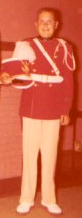
After several weeks we had the music memorized and the drill down to perfection. Soon the big day, or night, came. I put my uniform on, and my parents took my picture standing in the living room in front of the mantel, where we took all our pictures. (See above.) When I came out to get in the car, the neighbors sitting on their porches clapped their hands and cheered. I waved, modestly. The power of the Big Red Band.

In the band room, we sat in our usual chairs while Frank gave us some last minute advice that no one paid any attention to. We tuned our instruments. This was accomplished by Frank telling the first chair flute/piccolo to play an A note, whereupon the rest of the band tuned on this note. Just another of the godlike responsibilities of being a piccolo player. Because I did this for so many years, to this day I can hum a perfect A. Then we sat around and joked until Frank finally said to form up and head into the stadium.

The opening drill, which we had practiced many times, was very simple: The spectators would be in their bleacher seats and the two football teams were on benches along the sidelines. The band would form up outside the stadium, march in quietly, and stand in the end zone in 12 rows of eight players. When the head drum major gave the signal on his whistle, we would break into the first march and after a few bars head off down the field in perfect step, march to the other end of the field, stop in front of the goal post and wait while the US flag was raised up the flagpole. When it hit the top, we would play the Star Spangles Banner. When this was finished, we would march off the field, playing, and head back to our seats – folding metal chairs — on the sidelines. As I said, simple. Just like we had practiced a hundred times before.

On the night of our first game and performance, right before we started to march into the stadium, our lead guy down at the far end of our row looked over at us and said, just loud enough for us to hear, “Listen. When you get out there, no matter what happens, Keep playing!” I could hear this advice being repeated up and down the ranks: Keep playing! Keep playing!

What was he talking about? What else was I going to do? I’d been practicing this moment for weeks; I knew the music, I knew the drill, I was nervous but pretty damn confident.

We started off, the drummers playing “on the rim,” which means they were not using the head of the drum, but just quietly drumming on the rim, just loud enough for us to hear and march to.

We formed up in the end zone and straightened our lines. The night was clear; clouds of insects dive-bombed the towering stadium lights. The audience in the bleachers was on their feet, completely silent.

The drum major raised his long baton, blew a piercing blast on his whistle, lowered the baton and we broke into whatever march we had been assigned. A few bars into it, the drum major blew his whistle again and we stepped off as one, out onto the field. A few bars after that, about the time we hit the exact middle of the football field, all ten thousand spectators began cheering and clapping and stomping their feet.

It was the loudest sound I had ever heard in my life.

I was stunned.

I immediately stopped playing.

Which I knew was wrong.

Keep playing!

I could see some of the other first-year guys, and they were as shocked as I was. Really, no one told us about this. Even if they had, we wouldn’t have believed how loud the crowd sound was down on the field. The veterans were playing, covering up the fact that we new guys were struggling to get back into synch with the rest of the band.

I began playing, a kind of feeble tweeting noise that only vaguely resembled the notes I should have been playing. I was gasping for breath, trying to get back some semblance of control. At least I had the presence of mind to see where I was, where I was approaching, and to hit my “mark” and stop moving forward. I regained enough control to play the notes of the march, which finally ended, thank God.

We stood in silence. Except for the thudding of my heart.

The head drum major whistled us into the opening bars of the Star Spangled Banner. I got it together and played my part. We finished, there was a moment of silence, then the crowd broke into cheers and stomps again. We started into another march, about-faced, and marched back down the field and over to where our seats were.

It was the most exciting moment of my life.

#12 Shoot the Horse the War is Over

Christening

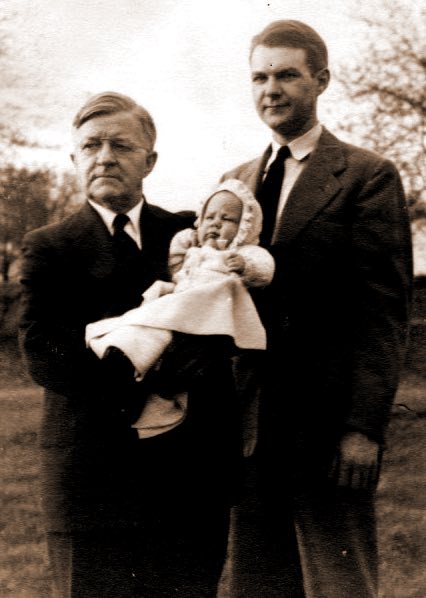
I was sitting on the couch in my living room the other day reading a book. I looked at the mantel over the fireplace where we have a thick scattering of old pictures and unusual knick-knacks. There’s an old photograph of me, taken the day of my christening, seventy years ago. My grandfather, who was a Lutheran minister, is holding me. My father — young, slicked back hair, handsome — is standing with us. I notice how tall my father is. And how short my grandfather was. And I realize that my father wasn’t tall at all. He was actually shorter than I am now, so he must have been around five feet six inches. Or less. My grandfather comes up to around my father’s chin.

Jesus, I thought, he was really short. What? Five feet tall? Less than that?

Why have I never realized this about my grandfather before? I’m sure, dear reader, you are probably sick of my coming to these size-related epiphanies after seventy years of the blatantly obvious. But there they are. I’m mystified at my own cluelessness as well.

Some of my first real memories were occasioned by my Grandfather Appel. I understand that some of what I’m putting down here is probably false, or at least tinged by recollections that I heard from other family members or just made up in my own head. I’m trying to keep it as honest as possible, but honesty is probably, at least in a remembrance like this one, not going to be strictly possible. Or even necessary. Or valuable.

My grandparents, my father’s parents, lived in Bethlehem, Pennsylvania. I remember their house as vast, with grounds that extended in the back to a sylvan woods and garden, choked with rose bushes and grottos where you could sit on shaded benches, peering out through lush vegetation, seeing, but not being seen. Years — many years later — on a trip with my mother back to Bethlehem, we found their little house, and I would realize, once again, that it was me that was so small, not that the house was so large. The yard looked to be simply a yard, not the bosky gardens that I remember.

My tiny grandfather was a Lutheran minister. His wife, my grandmother, was a thin dour lady who would later contract diabetes and spend her waning years sitting in one of the first recliner chairs I had ever seen. In those years she lived with my aunt and uncle in Bethlehem. We would travel there on vacation for a week every year and stay at their house. It was a cheap vacation, all we could afford, and it never seemed to me that they were ever all that happy to see us roll up in the Chevy station wagon. Shortly after arriving we would have to go and sit with sourpuss grandma for a few minutes and ask her how she was doing. This was excruciating to us kids. We had no idea what to say to her, and she was as old as God and smelled as sour as she looked. I’m sure she enjoyed it no more than we did. Even my dad looked pained as he sat and attempted to make conversation with her.

“So, how are you doing, Mom?”

And she would give him a look that showed just how stupid she thought the question was.

But Grandpa Appel was a wonderful man. I must have been five or six years old when he died, but I clearly remember some of our visits there. Every evening we, my sister and I, would be given baths in the same tub, then dried and put into pajamas, and then Grandpa would come in the bedroom with tiny glasses of grape juice, the glasses being the ones he used in the communion ceremony, as was the grape juice “wine” for our midnight snack. After which we would go to sleep in the same room that my father lived in when he was a child.

When we were a bit older, my dad would tell us a story of lying in bed in this room, recovering from typhoid fever, when the First World War ended, November 11, 1918. (I just looked it up. It was the eleventh hour of the eleventh day of the eleventh month. Isn’t it interesting that I have the exact date and time that my father had this experience.) He would have been seven years old, and hearing the church bells throughout the city of Bethlehem as they chimed to mark the end of the war. At the same moment as he watched out the window a horse that was hauling a wagon fell in its traces and sprawled in the street, unable to get up. The driver shot and killed the horse. This image – my father watching this scene out the window, the bells pealing — sat in my child brain with little or no adornment. I had no idea what to make of it. I still don’t know what to do with it, except it would probably make a great opening for a novel.

One day as a child I was sitting on the floor in the living room in Bethlehem, and I heard Grandpa Appel answer the telephone. He began speaking in a language I didn’t understand. I had no idea what a foreign language was. I would later learn that Grandpa was speaking Pennsylvania Dutch, which was common at the time. I thought that somehow he had gone insane, not that I understood what going insane was. All I knew was that I was terrified. This memory is interesting because I had absolutely no context to explain it. My Grandfather was simply jabbering, as if he were a baby. As I said, it terrified me.

On Sunday mornings we would lay on the floor and “read” the Sunday comics, which meant a man on the radio would read the comics as my grandfather would point out the correct strip and the correct panel while the man read. Dick Tracy, Orphan Annie, The Katzenjammer Kids. I remember them clearly. I remember being told that the man reading the comics was the mayor of New York, Fiorella LaGuardia. I just looked this up. Wikipedia says that this did indeed occur, Fiorella LaGuardia reading the comics over the radio every Sunday, but it was during a newspaper strike on August, 1945, at which point I would have been eight months old, so this is a “false” memory. I think I was three or four years old and Grandfather Appel was doing the reading and the pointing. I believe that this “reading” the comics led to my love of reading comic books and instilled in me a desire to read everything else, instilled a love of stories that stayed with me until I became the man who writes novels and this memoir.

How far I have strayed from my band days. Band uniforms. From what I gather from reading the Facebook, Once a Big Red, Always a Big Red site, band members today must buy their own uniforms. Ours were on loan to us throughout our four years and then turned back in on graduation. Here’s my memory of picking out our uniforms. We’re in the band room, and Frank has dragged out racks of uniforms for us, the new crop of freshmen, to try on. This memory is actually less clear than lying on the floor and listening to the Mayor of New York read me the comics. Anyone out there who is reading this, I’d appreciate knowing if I have it right, this trying on of uniforms. Where did these uniforms come from? I think now that there was a warren of rooms under the stadium that were band-connected, where the uniforms were stored. We tried on pants and jackets in a chaotic manner, and Frank sat at his desk and watched and cleaned his fingernails. It must have been a fairly simple procedure with racks of uniforms arranged by size. The problem was, yes, the smallest pants on the rack were way too large for me. I was terrified, but I had to ask for Frank’s help. Picture me, this little boy, probably in my underpants, holding up a pair of uniform pants that were far too large. He left the room and went in the back, and after awhile he came back with a pair of pants that dated from an earlier generation of uniforms, pants that were slightly off-color and with a slightly different color of stripe running down the side. They still didn’t fit, but these were evidently the smallest pants to be had, so Frank said to take them to my mother and she’d have to make them fit. This was before the pegged pants incident, so I had no idea what I was going to do.

Fortunately, I found a jacket and belt that fit fairly well, so I wasn’t completely humiliated. I took the pants home and my mother must have taken them to a tailor. I think the amount of work to get them to fit me was beyond even her talents. The entire four years in high school I never asked for a larger size. It seems I didn’t grow. As usual, I didn’t notice.

OK, one more uniform story.

I enrolled in West Virginia University as a freshman in 1962. I was 17 years old. WVU was, and may still be, a Land Grant College. I’ll spare you the long version, but Land Grant College legislation was enacted by the government in 1862 to allow poor people like me access to an affordable college education in which we were taught the values and techniques of agriculture and military science. By the time I arrived at WVU, that meant you had to take ROTC your freshman year. ROTC means Reserve Officer Training Corps. Excuse me if this sounds like I’m talking to a fourth grader, but I have a feeling there are plenty of people out there who don’t know what ROTC was. You had to take one year of military classes; if you re-upped for a second year after graduation you would automatically go into the US Army in the officer training program and come out the other end as a Second Lieutenant. And in my day that meant you would be headed straight to Vietnam. This was before the lottery system.

All the male freshmen were required to take ROTC. This meant we had classes a couple of days a week, learned to march, some basic military theory, how to take an M1 rifle apart and put it back together. Not that we ever got to shoot one.

OK, review the last paragraph. One of the things we had to learn was how to march. And who was the best marcher in the entire freshman class at WVU? Yup.

Me.

After all, I had four years of practice and had gotten my ass kicked enough times to drill the basics into me until they were engrained in every fiber of my body.

Early in the semester, we reported to the guys who handed out army uniforms for the ROTC class. I know you can see this coming. After a frustrating half an hour – frustrating for the poor guy who was handing out the uniforms – I was told to leave without a uniform and expect to be called back in later. Eventually, I received a notice that I had to see the head of the ROTC program. This meeting took place in the campus armory, where we had our ROTC classes. The armory was a big, old wooden building that smelled of wool uniforms, gun oil and dust.

I dutifully reported to the commanding officer’s office. The craggy, buzz cut, grey-haired US Army officer looked up from a stack of papers. I didn’t know if I was supposed to salute, so I just stood there in a parade-rest attitude.

“Son,” the officer said, sadly, “I’m sorry to have to report that we did a thorough search and there is no uniform in the entire United States Army that is small enough to fit you. I’m afraid that you’ll have to take part in all the normal activities that come with being an ROTC (pronounced Rot-see) cadet, only you will be wearing your street clothes.” He looked like he expected me to be crushed by this news. I put on what I hoped was a mournful look, saluted and left the office.

So I attended all the normal duties — marching, etc. — except I got to laugh at all the poor bastards who had to wear their US Army uniforms all day the two days a week we had ROTC classes. Hot wool uniforms, winter and summer, and you had to wear them from morning till night, not just to class. This culminated in a year-end military graduation ceremony that was held on the football field in front of a reviewing stand. There I was, leading my freshman ROTC class, complete with flying flags and a rifle-carrying honor guard down the field as I piped out the marching orders in my high clear voice. Dressed in my street clothes. It must have been quite a sight: the tiniest man/boy in the US Army.

After the review, the head officer, the man who told me there was no uniform for me, called me into his office again and tried to convince me to enroll for a second year in the program. He was sure a growth spurt would hit me at some point in the next four years (it turned out he was correct) and that a smart fellow like myself who could march so well, lead the troops on field and got good grades in his military studies (it wasn’t particularly difficult to manage that) would have a fine future in the US Army. And they would pay for my education. I turned him down.

I never told my parents of the offer. They would have pressed me to accept. I knew it wasn’t easy for them to come up with the money for both me and my sister to go to school, but, as we used to say, the times they were a-changing and the hippie days were descending upon us even in West Virginia, and the antiwar movement was beginning to build. Several years later I learned how smart my not joining up was.

One of my friends in the band, Mike Reeler (saxophone) went to Ohio State University after high school on a Navy ROTC scholarship and hated it. Or at least he hated the ROTC part. But he was a kid without a lot of money and needed the scholarship. Towards the end of his senior year, he was doing badly in one of his military classes because he mostly skipped going to class and was warned that if he didn’t pull his grade up he would lose his scholarship and wouldn’t be allowed to go into the Navy! He saw this as his ticket out of the program and proceeded to flunk the course on purpose, which infuriated his officers. They vowed revenge. Two weeks after he graduated he was drafted into the Army, two weeks after he graduated from boot camp he was sent to Vietnam and two weeks after that he was dead. A sad end to a great guy.

I didn’t get drafted when I eventually graduated, but that’s another story for another time.

#11 Getting Shot and Pegged Pants

I don’t remember what we told our parents we were going to do on those weekend evenings when we announced we were headed over to the city park. Maybe we just said we were going to the park. No one cared. This was simply an extension of the freedom we had known since we were able to get ourselves out the front door in the morning and into the neighborhood on our own. All the mothers in the neighborhood were there if something dire happened, to staunch any bleeding and drive us to the emergency room, but they certainly didn’t keep watch over us. We were always far out of sight anyway.

We, perhaps the last generation who enjoyed this type of upbringing, are always yammering on about how free and idyllic those days were, I’m sure to the irritation of today’s parents, who have to keep ever-vigilant eyes on their children and short leashes used to drag them out of the dangers that await them on every street corner, primarily sex perverts and serial child killers.

Each time we met up in the park, one of the gang, usually the same three or four guys, was assigned the duty of bringing the evening’s liquor. This was a revolving responsibility that fell to each in turn. Everyone’s father had a liquor cabinet of some sort. Ours was in a large cabinet that held decorative dishware. The booze was underneath the glass part where the plates, small porcelain statues and other items were displayed. In the bottom cabinet there were bottles of various liquors that were hardly ever touched. Nobody drank much in our neighborhood, or rather they drank one thing and the old dusty bottles like the Rock and Rye and the Manischewitz remained undisturbed for years at a time. (Although the Manischewitz was dragged out when we had a sore throat or bad cough. Miraculous medicinal qualities were attributed to it by my father. We kids hated it when he had us drink a small glass of this sticky sweet wine.)

So we would find an empty soda or liquor bottle and pour a little bit from all the other bottles into it – wine, whiskey, gin, anything that was there — mixing them without any thought as to taste. Then we would bring this to the park.

Darkness. We would meet near the tennis courts where there were lights, though we hung around on the edges of the illumination, in the shadows. We would sit on a picnic table and pass the bottle of mixed liquor between us. It should have tasted horrible — it no doubt tasted horrible — but I don’t remember anyone ever complaining about it. After a while we’d be pretty drunk. That’s when we played our game.

Steve (drums) had a small derringer pistol he had found in his father’s belongings. It was quite beautiful, engraved, silver and gold.

Let me pause here to insert a quick tutorial of guns and other weapons we kids possessed. For most of us, that would be none. Buying a handgun was an impossibility, particularly because as far as I know there weren’t any. I imagine some fathers smuggled pistols back from the war, and cops had sidearms, but the general public walked around the streets of Parkersburg, West Virginia, pretty much completely unarmed if you don’t count pocketknives. Dangerous knives, as opposed to pocket knives, were on our wish list, particularly switchblades, which we assumed were carried by every hood in town, though we only saw them in comic books and not in real life. The Movie, Blackboard Jungle, had been released a few years before and while I don’t remember if it ever played in Parkersburg,  though I’m sure it must have, there were enough popular references to it and images from it that everyone knew what a switchblade was supposed to look like and the damage you could do with it. Even just the pulling it from a pocket and opening it one-handed with an ominous snick would be enough to scare away the toughest hoods. Everyone wanted a switchblade — black, sleek, deadly — though nobody knew where to buy one.

When the band went to New York for a competition we had our chance. Since our seedy “hotel” was located around Times Square, we quickly found many pawnshops and small stores that featured knives of all sorts. And there they were, the classic switchblades that we lusted over. Unfortunately, they were for display purposes only because the Switchblade Knife Act of 1958 (brought about by the furor over Blackboard Jungle) prohibited their sale. There was a general understanding that indicated that you could buy one of these display knives if you really wanted to, but you had to be 21 and they were too expensive for us anyway. The dream died, and we returned home, defenseless.

One of the guys in our group, I can’t remember who, had a cousin from Philadelphia who turned up one summer for a couple of weeks. Let’s call him Ernie. He was our age, and he had a reputation as being a member of a real, organized street gang, and, best of all, he was armed. He was the proud owner of a gravity knife, which he called a flick knife. It looked like a large pocketknife and opened when you flicked your wrist, whereupon the blade would snick open and lock into position. It sounded cool, and the little wrist twist looked cool. He laughed at our quaint notions of switchblades, and asked up why anyone would want to carry a knife in his pocket that could flip open if you accidently bumped the button on the handle. What would happen then, he asked with a leer? We all nodded solemnly, paling slightly at the mental image of a knife blade flashing through thin pocket material and into your penis and scrotum. No more switch blades for us! Now we all wanted a flick knife. Not that we were any closer to finding where we could acquire one.

Ernie, in his brief stay among we rubes, showed us how to build a zip gun, which he said were fairly plentiful in his gang, and very useful in the many street battles he and his brothers were involved in. He drew up a nicely detailed plan on a sheet of typing paper. You took a piece of wood around six inches long and a couple of inches wide and nailed a shorter version of same on the end at a 90 degree angle to produce a gun shape. You found an old sliding bolt brass lock — they were everywhere in those days — and screwed it to the top piece of wood, positioned toward the rear over the handle. Then you broke off a car antenna, something Ernie said he and his mates did as a matter of course just to cause a little trouble, and cut it off so it was four inches long. This you attached in front of the sliding bolt with strong rubber bands made out of sliced-up, thrown-away tire inner tubes. Then you positioned more rubber bands so that they stretched from the front of the top wooden block, back to the little handle on the sliding bolt. Insert 22-caliber bullet into the antenna, pull back the band-powered bolt, release same and the bolt would hit the bullet causing it to discharge.

Simplicity itself. If anyone would like me to draw this up for you leave me a note in the comment section.

After Ernie left, there were long discussions about actually building one of these zip guns, but as far as I know no one actually went ahead and did it. It seemed like an awful lot of work, especially since none of us had ever fought in a street war, or even knew of one in our town. Back to the City Park and Steve’s father’s derringer.

It must have been a 30-caliber or larger, and we had no bullets that actually belonged to it. But Steve had figured out if you put a .22 in the breech on top of a piece of wooden matchstick, the thing would fire. The bullet would rattle out the short barrel and depending on luck and physics be powerful enough to hit anything in a fifty foot radius with some accuracy. That anything being one of us, running, trying to get far enough away so we would not be injured by the bullet.

Could anything have been more stupid?

One minute we’d be sitting on the picnic table, then Steve would shout, “Run!” and we’d be off in three different directions. Steve would decide who to shoot and pull the trigger. Sometimes he missed. It was dark, the bullet was as wrong as it could be, we were running and dodging, drunk, and yet when all the stars aligned correctly that bullet hit you in the back with a punch that hurt like hell. No one was ever really injured, no skin was broken, but it left a giant bruise that you had to hide from your parents. Everyone would laugh and that would be the end of it. Death had been averted. We would finish the bottle and stagger home. No parent ever seemed to notice when we came home in this condition.

After three weeks of summer band practice, the new guys were getting pretty good and things had settled down. The ones who were never going to make it had quit; a few were kicked out by Frank as being too stupid to memorize the music and the drills; the ass kicking had dwindled, though it never really stopped. As a deterrent to bonehead mistakes, it worked pretty well.

Summer in small towns, at least my small town in those days, didn’t offer a lot to do, other than getting shot at with Steve’s dad’s derringer. Summer band practice gave not only the band members something to do, but the town participated as well. I’ve mentioned that we marched on the broad grassy campus to the right of the school, alongside the long horseshoe driveway that circled around in front of the main school building. The building itself looked like a small college, built in a classical, vaguely British style.

Evening practice ran from five to seven PM as long as it wasn’t raining. We would gather in the band room, play a few marches and head out to the field. On those warm summer evenings we would always find a line of cars parked at a 45-degree angle along the side of the horseshoe drive that was closest to the field we marched on. The entire side of the horseshoe was filled with cars and perched on the fenders and sidewalk were those young women and families who had driven to the school to watch the band practice. Which must have been interesting for them in the early weeks when we were still getting kicked with regularity.

There was a sort of hierarchy in the parking, with the girlfriends of the band members positioning their cars on the upper reaches of the horseshoe, nearer the head of the field where we formed up. The line of cars stretching down the horseshoe would devolve into friends of band members and then just native Parkersburgians, moms, dads, and kids who wanted to listen to the music and watch the drills go from total chaos to choreographed precision.

After an hour’s practice, Frank would give us a fifteen minute break. The older guys with girlfriends — the cool guys — would go over and lean on sun-warmed cars and talk to their pretty girlfriends in their pretty summer dresses or fashionable Capri pants. The girls would be sitting on fenders or leaning against polished chrome bumpers and grills. The cars were mostly Chevys and Fords from the design era that was right before the really exotic tail fin, space-ship look.

We, the freshman, could only gaze upon these beauties, these relationships, from afar, or at least as far away as the trees at the head of the field where we stretched out to sit and rest until Frank formed us up again. I will not lie, the scene evokes a time of ease and joy, a quiet before the sixties arrived with all its war, racial strife, political disasters and tumult. As I have said, I knew there were enormous problems loose upon the land, but in the four years I was in the band, these summer practices were simple pleasures that I’m not sure still exist, at least not night after night, year after year. I hear many people — most people — lament their high school years, and I always wonder at it. I’m not stupid, I understand the destructive nature of adolescence, the cruelties those years can bring, but I can’t really join in these lamentations. I can only remember these soft summer evenings, and the pretty girls in their colorful summer dresses.

No cut-off blue jeans. And the shorts were conservative. During the school year the only kids who wore blue jeans were the “hoods” and the really poor kids. Girls wore skirts and dresses, maybe pants that would be called slacks. The boys wore chinos which would be, well, chino colored, or black. Anyone who wore pants of any other color was considered a hick. At least until the pink and charcoal grey craze.

This was about the time that “pegged” pants came into vogue, taking the high school hallways by storm. It would later be relegated back to the hoods, but when it burst upon the scene only the coolest guys were wearing pegged pants. And I was not what you would call a cool guy.

Remember, I was tiny. I wore thick, horn-rimmed black glasses. I was on the debate team. We shopped at Sears and Roebuck. But also remember, I was in the band.

I needed a new pair of pants. Not because I had outgrown anything, but because it had been awhile. My mother took me to the boy’s department in Sears, which I was distressingly well acquainted with. When I was younger we would go there, and I would climb up onto the shoe machine that shot deadly x-rays through your shoes and showed a ghostly image of your feet and bones, all glowing a lurid green. Oh what fun that was. It’s a wonder we all didn’t have foot cancer by the time we were in our twenties.

My mother found me the usual boys pants and sent me into the dressing room, where I would try them on with the usual pathetic results. I was so small I fell between the size hell of Little Boys and Young Men. I refused the boy’s pants, and the Young Men’s were always too big and dragged the ground around my stupid shoes that we bought in the little boy’s department because my feet were as small as the rest of me. No one wore sneakers, just plain tie-up shoes. When I went to college I discovered Bass Weejuns – loafers — but until then it was plain black or brown shoes. Were they Buster Brown’s? I shudder to think that they might have been.

In my new ill-fitting pants, I slunk out of the dressing room and stood in front of the giant, floor-length, three sided Mirror of Shame. The pants sagged, as all the pants did on my undersized frame. My mother said she could hem them. She had to hem everything I bought. She could see I was pretty discouraged about the pants. I told her what pegged pants were, and how they were really cool. But Sears and Roebucks didn’t sell pegged pants. My mother listened and said, “I can do that.”

“What?”

“I can peg your pants.”

How the hell was she going to do that? We bought the pants and drove home. She went upstairs and worked on her sewing machine for an hour or so then came down and tossed me the pants. “Try them now.”

I went upstairs to my room and pulled the pants on. They did not drag on the ground. They were tight on my legs. I went in to my mother’s bedroom where there was a full-length mirror.

They were pegged.

I looked fabulous.

For the first time in my life, I felt a great sense of admiration, mixed with awe, about my mother. I knew she was a good mother and took care of our family, a tough job because my father was only home on the weekends, but it had never occurred to me that she had skills. Serious skills. I didn’t know much about sewing, actually I didn’t know anything about sewing, but I knew she must have taken the pant legs apart and then sewed them back together again in some way that made them tighter. I went downstairs and showed her.

“They look good,” she lied. I thanked her for doing the sewing. I didn’t say anything about her skills, but I think she could tell I was more than appreciative. She had a small smile that said, See there, there’s more to me than you will ever know. Which was right. That was a lesson I learned and relearned over the years.

So I went to school in my pegged pants. No one mentioned them. Which was probably a good thing. I must have looked pretty foolish, my little self in tight pants with my googly glasses and my stupid shoes.

But I felt cool. That was enough.

#10   Here Comes Peter Cottontail; the City Park; Fuff 

Lilly Pond in the City Park. Picture from Roger Mackey

The new members of the Big Red band were given a packet of music – marches — to learn. Many were by John Philip Souza, not much of a surprise there, and others were by composers I had never heard of. These were packaged in small portfolios, around eight inches by six inches, enclosed in a snap package with a clear plastic front, which made them pretty much waterproof. I’ve said that some bands mounted these music portfolios on special music stands strapped to their arms so they could read the music as they marched. We sneered at any band that resorted to this method. Pussies. We memorized the marches. The drills were too complicated to perform if we were looking at music as well. So we, the new boys, memorized the marches. And woe betide anyone who couldn’t play every one of them from memory.

Everyday in the summer we went to the grassy lawn in front of the high school for marching practice. Before going out front, we would warm up by playing the marches in the band room for fifteen minutes or so. If Frank thought someone, a new guy, was faking his way through the music, he would stop the band, point at the offender, and say, “Turn your music over.” Which meant you then had to play the march, from memory, all by yourself, without the psychic and practical help of an entire band around you. These were terrifying moments, and you could get reduced down the ranks for a bad performance. If you flunked one of these challenges, once out of the band room you knew someone was going to kick your ass all the way down to the practice field. I saw this happen on several occasions, so I broke my usual lethargic practice schedule and learned the marches well enough that Frank, who seemed to have a preternatural ear, couldn’t hear me faking my way through a piece of music.

Semper Fidelis, The Washington Post, The Thunderer, El Capitan, are all classic marches that we would play while executing drills. If you listen to recordings of them today, (they’re all on the Internet) one thing you will notice that is common to all of them is the one instrument you can actually hear individually is the damn piccolo. The masses of brass, lead by the cornets and underpinned by the trombones and sousaphones take the lead, with the reeds — the clarinets and the saxophone filling out the wall of sound — and over it all, flitting, dancing, is the piccolo. You don’t need a whole section of them, one will do, just as that music teacher told me years ago in grade school, it is the littlest, but it is the loudest.

There were three broad lawns that stretched in front of the high school down to the street. A giant horseshoe drive arced up and around the front of the school. We practiced through the month of August, two times a day, two hours morning and late afternoon, on the right-hand lawn, as you looked from the street toward the high school. If the first two weeks of the month was a sort of hell because you were getting your ass kicked, the last two weeks were another sort because of the heat. Even though we worked in the morning and the late afternoon/evening, it was still hot.

The grass was laid out with limestone lines exactly like those on the football field. There was a kid who did this, limed the practice field, and redid it every time the rain washed the lines away, or we wore them away by walking on them. Looking back now I see him as a sort of unsung worker hero who probably never got the appreciation he deserved.

The evening practices had a magic to them. You have to remember this was a small town, West Virginia, in the late 1950s. I’m sure there were the usual bad aspects to our life — poverty, inequality, stupidity — but we, or at least I, didn’t seem to worry about any of that. Maybe the adults were worrying about the Korean War, racism, the atom bomb and other societal ills, but we weren’t. Everyone had enough money to live on and even those who had a lot of money didn’t live very differently from the rest of us. The band was a great leveler: you learned your music, the drills and you did your best. If you didn’t, you got your ass kicked. Outside, there was another world, but we didn’t live in it. The social revolution of the 60s had not yet befallen us; we existed in a lovely haze of hot, halcyon summer days, golden evenings and privilege.

There wasn’t a lot to do in Parkersburg. One of the main attractions was the large city park just a block from our house. You would go there to swim in the pool, fish and feed the ducks in the pond (the Second Largest Man-Made Lily Pond in the World, it was said. Really? The question always in my mind was why was it the second largest? Where was the first largest? It was rumored to be in Japan, but no one really knew.) In the winters the pond froze over, and we ice-skated on it, building bon fires, roasting marshmallows and skating until we were exhausted. When we got back home there was always hot chocolate. We picnicked in the park, played on the swings, and climbed the memorial aircraft gun commemorating the dead from WWII. There was a log cabin museum in the park which never seemed to be open. And a band shell where members of the band would sometimes play concerts on the weekends; the townsfolk would bring blankets and sit on the grass and enjoy the music while little kids ran around. There was a small zoo. I related in an earlier entry that one year a drunken hunter climbed over the fence and shot one of the deer and was caught by the cops trying to drag it over the six-foot, chain-link fence. As my friend Butch reminded me after I posted that entry, the fact that the hunter was a city councilman made this crime even more amusing.

There was a curious bunch of men who would hold meetings in the park at least once or twice a summer where they would bring motors, noisy gasoline engines of all sizes, and set them out on the grass and start them up and leave them running for hours while they sat around in lawn chairs and listened to the infernal racket of the popping, sputtering engines. Why? I had no idea, but they always seemed to be enjoying themselves.

At least once a year, usually twice, small carnivals would set up for the weekend. There would be rides and games and carnival workers who appeared very exotic to us, leathery, thin, tanned sly-looking people, men and women, who tried to cajole you into tossing rings, firing BB guns, or pitching ping pong balls into small glasses with goldfish. No kid’s mother was ever pleased to see you come home with a goldfish. If you won one it would surely be dead within a couple of days. No one ever won any of the decent prizes.

In the summer the park was filled with picnickers and extended families holding annual family reunions. There were long covered shelters with end-to-end picnic tables where these reunions were held, much coveted, sheltered spaces because of the possibility of rain. On a summer weekend when a reunion was scheduled a member of the family would be assigned the job of going over on a Friday night and sleeping on one of the picnic tables in a shelter so no one else could grab it the next day for their own reunion. I hated our reunion, the Bush family reunion, mostly because as a kid you were continually besieged by at least three or four hundred (no, I am exaggerating) very large aunts who were all enormously fat with arms the size of smoked hams where the skin of the upper arm flapped heavily, bosoms that threatened to smother you and facial hair that tickled and prickled when they gathered you up and gave you kisses. Acres of country dishes were spread out on the tables with several grills nearby pumping out platters of grilled chicken and hamburgers and hotdogs. The men worked the grills and played horseshoes, and the kids just ran around and around. As much as I hated it, I also loved it.

We went to the swimming pool almost every day in the summer. We had books of tickets, one of which you would hand over to the bored teenager at the entrance who would give you a basket that had a number on a small metal plate and a giant safety pin with the corresponding number attached. You’d go into the appropriate dressing room, change your clothes and stash them in the basket and hand it to another attendant behind a beat-up, wooden counter on the way out. The safety pin was attached to your swimming suit. You would give it back to the attendant as you left the pool, and it would be matched with the basket with your clothing so you could change into your clothes and head home for dinner. We would be at the pool for hours and hours and usually had the sunburn to prove it.

One year when I was very young, my Aunt Mary was in town, and she took me to the pool. Because I was so young she dragged me into the women’s side to change my clothes. There were no cubicles there, just benches with all the women stripped down as they were changing. Beside me, an enormous fat woman, and I mean really enormous, stark naked, bent over to put her suit on and her giant behind was so close to me I was severely traumatized; I told my mother I would never go in the women’s side again, no matter what, and I never did. I went in alone on the men’s side and changed by myself; if a pervert had kidnapped me and made me his sex slave I would have preferred it to ever having to see another fat woman’s ass the size of a Volkswagen bus.

Here’s a city park story.

The summer I joined the band I was fourteen; most of my friends were fifteen. By the next summer, the oldest would have their driver’s licenses, which greatly expanded our roaming range. But this summer we were on foot except when our parents gave us rides to wherever we were going. The city park was centrally located to the houses of our small gang that met there at night on the weekends. We certainly weren’t going to have our parents drive us to the park for these revels, nor did we need them to.

These were pre-mall days. In many ways having malls to drop young teens off is a godsend for parents. They’re indoors, climate-controlled, patrolled by their own police forces, clean, have food and drink and provide all sorts of legal entertainment. The city park, on the other hand, was dark and provided plenty of semi-hidden places for small groups of young men up to no good to gather.

There were usually three or four of us: me, (piccolo); Jim Green, (cornet — his brother Dave was first trumpet and one of the leaders of the band); Steve Telemeyer, (drummer — his brother was first clarinet, another leader); Bill Parker, (drums) and Bill Stone, known as Stoney, another drummer. My closest friend Jake Patterson, clarinet, and my neighbor, the aforementioned Butch McGee, drum major. Not that we ever took our instruments to the park with us. Well, actually we did. One night very late we sneaked over to the park and sat in the dark in the band shell and played marches. No one seemed to notice. Or perhaps they did, the music floating in through half-opened windows, causing sleepers to stir and dream of Friday night football games and marching bands.

Our families stretched across the social strata; they knew each other, but didn’t really socialize. The band was the only connection for the adults. Jimmy Greens father ran a dump truck, dirt-hauling business and was rumored to have spent many years traveling across the United States in carnivals before creating his trucking empire. The Greens lived in a new one-story house that was unlike the older homes that the rest of us lived in. His mother was young, and even we, callow youths, knew she was very beautiful. Jimmy’s father was tough and took absolutely no crap from his three boys. Or, we were afraid, his beautiful wife. The oldest brother raced stock cars on mud tracks. Sometimes we went to see him race, and everyone in the audience hated him and booed him, but as far as we were concerned, he was a hero.

Steve Telemeyer’s father was a respected doctor. They lived on a beautiful, tree-lined street of stately homes. We never saw his father, and his mother seemed to exist only in the semi-darkness of their brick home: quiet, frail, delicate. She always seemed faintly amused at our group of boys.

Bill Parker’s father was the head of one of the sprawling chemical plants that lined the Ohio River near our town. He was a big-deal kind of guy, but was hearty and helpful, willing to drive us when he was free, a wonderful father who bought me my first decent steak. More on that later. Bill’s mother was a tall lady, privileged, aristocratic (for West Virginia) probably bored, another mother who observed us with calm bemusement. We liked her. Jake lived fairly far out of town though I was at his house often; more on his parents later.

My mother was much closer to my friends than these other ladies, a sort of den mother who was always willing to pitch in on whatever project — no matter how whacky — we had thought up and needed help executing. She could also be counted on to feed anyone who happened to show up at mealtimes.

I was surprised at one time, back then, when we thought up a really twisted stunt and enlisted her help and she pitched right in. In fact I’m still surprised at it.

Easter was coming. One of the Parkersburg traditions was the annual Easter egg hunt in the city park. As a child attending, in previous years, I had noticed that most of the eggs were snagged by aggressive parents who raced into the park at the given signal, children following, sometimes far behind, and scooped up all the obvious eggs and handed them over to their kids.

That year, the first year in high school, I came up with a plan. I believe it was Stoney and Jake who joined me in this endeavor of revenge. I decided that we three would pose as Easter Egg “Police.” Armed with clipboards, we would go up to every adult we could find grabbing eggs ahead of the children and take their names and addresses, telling them that the city would be sending them a ticket in the mail for breaking the rules of the hunt. I told my mother we needed three clipboards, told her what we intended to do, and asked if she could get them for us. She heard me out and decided it was a funny idea and went out and bought the clipboards and pads of paper for them. Not once did she say,” Someone is going to punch you in the nose,” or, “you’re going to get into trouble.” She just handed over the clipboards the night before the big egg hunt.

The next day, armed with the clipboards, we headed over to the park. There were probably 50 or 75 kids and adults, all formed up around the band shell, waiting for the starting bell to begin. Around us, in the nooks of trees, beneath bushes, nestled in the grass, were the plastic eggs that held small plastic trinkets. A public address system had been set up in the band shell. The announcer, I believe he was a dj for one of the local radio shows, whipped the crowd into a frenzy, called down the count and the egg hunt was on!

And the adults did what they always did.

We did what we had come to do.

Me. “Excuse me, sir?”

Man with small child in tow: “Yes.”

“Did you just pick that egg up from underneath that bush and give it to your child?”

“Well, yes.”

“Do you know that’s an infraction of the rules, which clearly state that the children are supposed to find the eggs on their own?” I tap on my clipboard as if I have a copy of the Official Rules right there.

“I was just helping her.”

“I think it was quite clear that you found the egg, not the little girl. Isn’t that right, little girl?” The little girl hides herself behind her father’s leg.

“I’m going to have to take your address. The city will send you a ticket in the mail.”

Silence.

“What is your name and address, sir?”

Here’s the crazy part — every adult actually gave us their names and address. We each corralled five people and the result was the same for each of us. The adults looked sheepish and trotted out their names and addresses without any more prompting or whining on their part. They’d been caught, and by God they would suffer the consequences. After five people each we called it quits, partially because we had proved our point and shamed the adults who were snatching up the eggs, and mostly because it didn’t cause any fuss at all and soon became boring. Can you imagine pulling a stunt like that today? We’d have been shot, stabbed or beaten by every “wrongdoer” we approached.

When we got back to my house and told our story, my mom had a good laugh and declared it a successful prank and served us all a slice of her famous chocolate pie with whipped cream. She didn’t actually whip the cream, but squirted it out of a can, which was a fairly new product for the time. We called the whipped cream “Fuff” because of the sound it made coming out of the spray nozzle. As in, “Would you like some more Fuff on your pie?”

We had another slice of pie and told the story again and laughed. I believe my mom laughed the hardest of us all.

Arf Arf!

For those who have written asking whatever happened to the parts about the Big Red Band, I’ll get back there shortly. Those of you who know me and my writing understand that I tend to wander around a lot on the page

Where was I? Oh, yes, many pages ago I was buying a flute, which meant a trip to the music store in downtown Parkersburg to look at a catalogue. As those of you have kindly pointed out, I got all the info about the music store wrong in an earlier entry. It seems the name of the store was Shroeder’s, (no relation to our esteemed band leader, Frank Shroeder). One of the pleasures of writing this memoir is knowing that my West Virginia friends out there will correct all the parts I get wrong. Thanks to everyone who is helping me.

The music store downtown… But first, allow me one of my digressions. For some reason, I remember that this store always reminded me, when I walked in the door, of the country store we used to hike to in Walker, and other West Virginia country stores of that time. I’ll bet many of you remember these stores. Old places built of, on the outside, grey, weathered wood. Inside they smelled of wooden floors, wooden counters and shelves, and dust, usually something fruity, maybe a barrel of apples or bushel of peaches, depending on the season. There was often a giant wheel of cheddar cheese, sometimes covered with cheesecloth. The cheese would sweat small beads of oil, and you could order a slice, which would be wrapped in butchers paper and tied with a string and it was delicious. The soda was in a large cooler, bottles jammed down in drifts of ice: orange crush, grape or other fruits that you never see any more, Cokes and Pepsis. You could buy about anything in those stores, and the old ladies and gents behind the counter were always nice to us kids with our nickels and dimes clutched in our grimy little fists.

The music store didn’t sell produce or cheese, but I remember it having long wooden floors, wooden shelves and wooden counters that had their own comfortable smell of age. They sold instruments, mostly guitars, in the front, records in the middle and in the back were glass booths where you could play records and make a decision on which you wanted to buy. No one seemed to care that you would go in a booth and spend an hour listening to records and come out and not buy anything.

Music was in the air much of the day around our house. My mother kept the radio on, a small, white plastic model that sat on a shelf in the kitchen, while she worked around the house. When my dad was home on the weekends, it was tuned to big band music; during the week my mother listened to a local, top-ten station. Some of the songs I remember clearly, many of which are still played today, were Smoke Gets in Your Eyes, A Teenager in Love, Lonely Boy and Lipstick On Your Collar. Well, maybe they don’t play them much anymore other than on oldies stations.

It was around this time, seventh or eighth grade, when my passion for classical music was born. It must have been a hot Saturday in the summer. Saturday, because my dad was home. We – my sister, mom and dad and I — were all in the kitchen. My dad was sitting at the white metal/porcelain kitchen table. He had on his weekend pants and a no-sleeve undershirt, what we now refer to as a wife-beater. We were kidding around, and the radio was playing a big-band show. The announcer said they were going to have a contest. He would play an old big-band tune, and the first person to call in and name the band would win a prize, which was an LP — a long playing record — and a case of soda. The tune started and my dad immediately said, Tommy Dorsey; I called the station and told them, and we won.

This was astounding. As far as I know, we had never won anything. The radio people took the information and sent us the paperwork. The next weekend, my dad drove to the grocery store and picked up the soda, a case of coke, and dropped me off at the store to pick out a record. And why did he drop me off? The store involved in the contest was our nemesis, J.C. Penny. Thank God it wasn’t Monkey Wards. Dad wouldn’t go in, but he figured that we would take the free record because giving it away would probably harm Penny’s and make them more vulnerable in the ongoing war that was Sears against Penny’s and Wards. (See earlier entries for more on Sears Roebuck.)

I had to ask directions to the record section because it was hidden away at the very back of the second floor of the store, behind the lady’s underwear section, which was mortifying, but oddly fascinating to walk through. I fought to keep my eyes straight ahead as I made my way through ranks of bras and underpants. Two bins held around fifty records, divided up into a popular music section and a much smaller selection of classical music. For some reason, I was seized with the notion of buying a classical record. I knew what classical music was, I had seen orchestras, dimly, on the neighbor’s television, and I had heard orchestras on the radio. Many cartoons of the time showed orchestras. I knew it was music that smart people listened to, rather than popular songs like How Much Was that Doggy in the Window. I thought if I listened to classical music, I too would become a smart person. I pictured myself sitting in a fancy living room, maybe smoking a pipe (I was an adult in this image) reading a book and listening to this type of music. Off to the side, sitting on the sofa would be my lovely imaginary wife, dressed only in a bra and panties.

No! That was a joke! I didn’t think that at all!

But how would I know what record to buy? For some reason, I decided that the best classical composers would be the ones with the longest, most foreign-sounding names. It turns out that this was not a bad way to choose, as I left the store with Rachmaninoff’s piano concerto #2 in C minor, one of the world’s great romantic pieces.

At home, my sister was disappointed by my selection. And it was then that we faced the next hurdle: we didn’t own a record player. Or at least we didn’t as far as I knew. Dad took us into the living room.

There was a large piece of furniture that I assumed was there mostly to hold a lamp and a couple of vases. I knew there was a radio in there, but we hadn’t listened to it for years, not since we got the small white plastic one. This was the sort of radio that when you turned it on it took some time to warm up. The sort of radio you could smell as it emitted a familiar (and somehow comforting) odor of dust and hot tubes. Dad opened the radio part, then from underneath he rolled out a regular turntable. I didn’t even know it was in there. We didn’t own any records other than the new one I had just bought. Well, actually we did, we had a half-dozen Disney records that we listened to when we were smaller. What did we play these on? I don’t remember.

Dad turned everything on, and we sat down to listen. Those first, brooding chords of the Rachmaninoff began and in seconds I was enthralled. I have no recollection of what anyone’s else’s reaction was, but I felt an entire world opening, a world that, like the record turntable, I had not known existed.

The next Saturday we won again. This time we picked up a case of orange soda, and my sister got to choose the record. She went with Frank Sinatra, which I didn’t have any interest in, you could hear him anytime on the radio, but I have a feeling the rest of the family was pleased with the choice.

The next week we won again and were permanently banned by the radio station from ever entering the contest again. This time the soda was root beer, and I was back at Penny’s facing the record bin. I employed my tried and true method and came home with Shostakovich’s (the longest foreign name in the bin) Preludes and Fugues. I put the record on, expecting Rachmaninoff, which is not what I got. The pianist started off innocently enough, but soon was hitting what even I knew were “wrong notes.” The rest of the record was the same and after listening to both sides, I was completely confused. I know now that this was the first time I had encountered dissonance in music, but I didn’t know that word and neither did anyone else in my family, at least when it was used as a musical term. I asked my father, who understood what I was talking about. He explained that once, years before, he had attended an Erroll Garner concert, a black jazz pianist who played in somewhat the same way. Dad said Garner was the man “who played the right wrong notes.” Making music that might sound wrong, but who, after awhile, made those wrong notes work. This was jazz, my father said, but the idea was the same with the Shostakovich. Give it time, listen and learn.

I wish I could say that I sat back down and listened to the Shostakovich again and the scales fell from my eyes, and ears, but it wasn’t so. I wore out the Rachmaninoff record, but the Shostakovich, not so much. I think I learned to appreciate it, and came to somewhat understand modern classical music, but it didn’t fill me with the same yearning that Rachmaninoff and other romantic composers did.

We ended up giving most of the sodas away. We almost never drank soda at home. I don’t know if it was because we were too poor to afford it, or that my mother didn’t think it was good for us. My parents didn’t drink any of it, and after a half dozen bottles of the various flavors my sister and I had no interest in it either. For some reason this was vastly different from those rare sodas we drank after walking miles down a dirt road, the sodas from the old country stores. There was so much of it, three cases stacked one atop the other in our kitchen, and it was so sweet to us that I remember drinking a couple of bottles, the way I’d seen other people drink them, and then feeling sick. I’ve hardly ever consumed a commercial soda since. Thank you, radio station. You turned me into a classical music lover and made a big contribution to my health all at the same time by teaching me to dislike soft drinks.

And because I love to get songs stuck in other people’s heads, here are the lyrics to How Much Is That Doggie in the Window. You remember the tune. Sing along to it, and make sure you add the “arf arf” at the end of the chorus.

How much is that doggie in the window?

The one with the waggly tail

How much is that doggie in the window?

I do hope that doggie’s for sale

I must take a trip to California

And leave my poor sweetheart alone

If he has a dog, he won’t be lonesome

And the doggie will have a good home

How much is that doggie in the window?

The one with the waggly tail

How much is that doggie in the window?

I do hope that doggie’s for sale

I read in the papers there are robbers

With flashlights that shine in the dark

My love needs a doggie to protect him

And scare them away with one bark

I don’t want a bunny or a kitty

I don’t want a parrot that talks

I don’t want a bowl of little fishies

He can’t take a goldfish for a walk

Arf! Arf!